

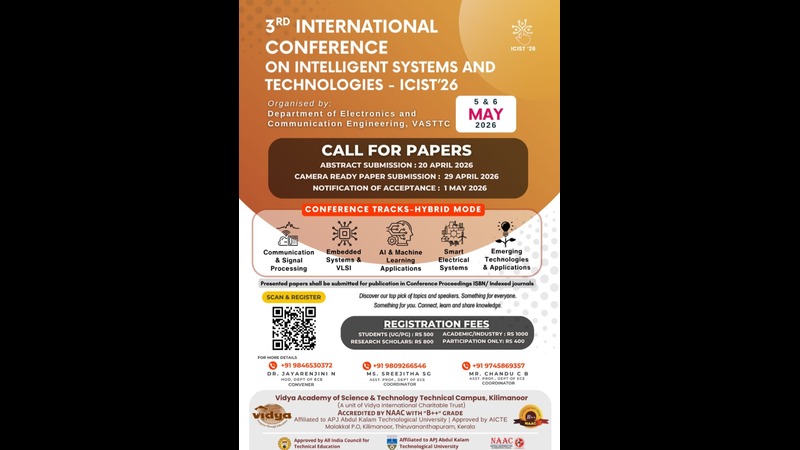
ABOUT THE CONFERENCE
The Department of Electronics and Communication Engineering is proud to announce the 3rd International Conference on Intelligent Systems and Technologies (ICIST 2026). The conference will be held on May 5 & 6, 2026, at Vidya Academy of Science and Technology Technical Campus, Kilimanoor. From revolutionizing healthcare to optimizing transportation, intelligent systems continue to reshape a wide range of sectors. ICIST 2026 aims to provide a vibrant platform for meaningful interaction and the exchange of research ideas among scholars, professionals, and students, highlighting the transformative impact of these technologies across industries.
ABOUT COLLEGE:
Vidya Academy of Science & Technology Technical Campus (VAST TC), one of the best Engineering colleges in Kerala is situated at Kilimanoor is a venture of Vidya International Charitable Trust (VICT). This college was established based on guidelines issued by All India Council for Technical Education (AICTE) and affiliated to the APJ Abdul Kalam Technological University. Within the short period, this institution has developed with its talented and committed faculty, high quality infrastructure, high technology teaching aids and by providing a serene atmosphere that complements academic life. VAST TC makes the students' life in the campus very interesting and purposeful. The students are provided with opportunities to take part in sports & games, cultural programs, dramas, various club activities and National Service Scheme. In addition, ample opportunities are provided in participating and conducting seminars, workshops, symposiums etc. The trust was constituted with a vision to provide higher education and training to our younger generation who will be highly sought after by leading business houses worldwide.
ABOUT DEPARTMENT
Electronics and Communication Department aims to nurture students' analytical and creative skills, fostering their ability to interpret and disseminate knowledge effectively. Our dedicated faculty, equipped with updated facilities, emphasizes teaching, research, and development. With well-equipped laboratories, we focus on fundamental subjects while exposing students to emerging
technologies like VLSI, Embedded Systems, Signal Processing, and Communications. Following an outcome-based education model, we prioritize quality improvement through feedback from stakeholders including students, parents, alumni, industries, and professional bodies.
OBJECTIVES
- Provide a forum for knowledge exchange and collaboration among researchers, academicians, and industry experts.
- Showcase cutting-edge research, innovations, and developments in the field of intelligent systems.
- Foster discussions on emerging trends, challenges, and opportunities in the domain.
- Inspire and encourage the next generation of researchers and engineers to explore the potential of intelligent systems.
Who Should Attend:
This conference is designed for researchers, academicians, industry professionals, and students interested in the advancements and applications of intelligent systems and technologies.
Why Attend:
- Gain insights into the latest research and developments in intelligent systems.
- Network with peers, experts, and industry leaders in the field.
- Present your research findings and receive valuable feedback.
- Explore collaboration opportunities with academia and industry.
- Stay updated on emerging trends and future directions in the domain.
Themes of Conference
AREAS OF CONFERENCE
TRACK 1: Embedded and VLSI
1. Embedded Systems Design
2. System-on-Chip (SoC) Design
3. Hardware/Software Co-design
4. Embedded Processor Architectures
5. Real-Time Embedded Systems
6. Low-Power Embedded Systems
7. Embedded Memory Design
8. Embedded Software Development
9. Field-Programmable Gate Arrays (FPGAs)
10. Digital Signal Processing (DSP) in Embedded Systems
11. Embedded System Security
12. Sensor Networks and IoT (Internet of Things) Devices
13. VLSI Circuit Design
14. Analog and Mixed-Signal IC Design
15. Digital IC Design
16. ASIC (Application-Specific Integrated Circuit) Design
17. High-Level Synthesis (HLS)
18. Verification and Testing of VLSI Designs
19. Physical Design Automation
20. Emerging Technologies in Embedded and VLSI
TRACK 2: Smart Electrical Systems
1. Smart Grids and Energy Management
2. Power Electronics and Energy Conversion
3. Smart Monitoring and Control Systems
4. Renewable Energy Integration and Smart Microgrids
5. Electric Vehicles (EVs) and Vehicle-to-Grid (V2G) Systems
6. Cybersecurity and Resilience
7. Power Quality and Harmonic Analysis
8. Energy Efficiency and Demand Response
9. Artificial Intelligence and Data Analytics
10. Integration of Smart Technologies
TRACK 3: Image and Signal Processing
1. Image Processing
2. Computer Vision
3. Video Processing
4. Signal Processing
5. Pattern Recognition
6. Multimedia Processing
7. Biomedical Image and Signal Processing
8. Emotion Recognition and Affective Computing
TRACK 4: AI and Machine Learning Applications
1. Natural Language Processing (NLP)
2. Computer Vision
3. Speech Recognition and Synthesis
4. Machine Learning Algorithms and Models
5. Reinforcement Learning
6. Generative Adversarial Networks (GANs)
7. Deep Learning Architectures
8. Robotics and Autonomous Systems
9. Recommender Systems
10. AI Ethics and Fairness
11. AI for Healthcare
12. AI for Finance
13. AI for Smart Cities
14. AI for Education
15. AI for Environmental Sustainability
16. AI for Cybersecurity
17. AI for Social Good
TRACK 5: Emerging Technologies and Applications
1. Artificial Intelligence and Machine Learning
2. Internet of Things (IoT) and Smart Devices
3. Blockchain Technology
4. Augmented Reality (AR) and Virtual Reality (VR)
5. Quantum Computing
6. Biotechnology and Bioinformatics
7. Nanotechnology
8. Advanced Robotics
9. Renewable Energy Technologies
10. 3D Printing and Additive Manufacturing
11. Autonomous Vehicles and Transportation Systems
12. Cybersecurity and Privacy in Emerging Technologies
13. Smart Cities and Urban Development
14. Wearable Technologies
15. Sustainable Technologies and Environmental Impact
16. Human-Computer Interaction
17. Advanced Materials and Manufacturing Processes
18. Edge Computing and Fog Computing
19. Big Data Analytics and Predictive Technologies
20. Telemedicine and Health Informatics with Emerging Technologies
Keynote speakers
Dr. VEENA RAJ
Lecturer,Faculty of Integrated Technologies,
Universiti Brunei Darussalam, Bandar
Seri Begawan, BE1410, Brunei Darussalam
Dr.LIZY ABRAHAM
Research Collaborator
South East Technological University, Ireland
Organizing Committee
Chairman
Dr T Mathavaraj Ravikumar
Principal, VAST TC
Convenor
Dr Jayarenjini N
Head of the Department,
Department of Electronics and
Communication Engineering(ECE),
VAST TC
Staff Coordinators
Ms Sreejitha S G
Assistant Professor,
Department of ECE, VAST TC
Mr. Chandu. C. B
Assistant Professor,
Department of ECE, VAST TC
Advisory Members
Dr. Lizy Abraham
Research Collaborator
South East Technological University, Ireland
Dr. Feroza Begum
Senior Assistant
Professor of General Engineering,
Universiti of Brunei, Darussalam
Ms. Lineeta Job
Configuration Manager,
ZF Group, Friedrichshafen,
Germany
Dr K. Rafeek Ahmed
Professor, Department of ECE,
School of Engineering
Presidency University Bangalore
Dr. Anto Sahayadas
Professor, Department of Computer Science and Information Technology
Symbiosis Skills and Professional University
Kiwale, Pune
Dr. Nelsa Abraham
Associate Professor,
Department of ECE, Rajiv Gandhi
Institute of Technology, Kottayam
Dr, Christy James Jose
Associate Professor,
Department of ECE,
College of Engineering, Trivandrum
Mr. Nandan. S
Assistant Director,
LBS Centre for Science and
Technology, Thiruvananthapuram
Registration Fee
Students (UG/PG) - Rs 500/-
Research Scholars: Rs 800/-
Academic/Industry: Rs 1000/-
Participation Only: Rs 400/-
Important Dates
Abstract Submission: 20 April 2026
Camera ready paper Submission: 29 April 2026
Notification of acceptance: 1 May 2026
Publications
All papers presented will be published in ISBN Conference Proceedings Journal.
Instructions to Participants
Submission Guidelines
Abstract of the full paper has to be submitted before 20th April 2026.
Full papers submitted on or before 29th April 2026 will only be accepted for presentation. At least one of the authors should register and present the paper in the conference. Presented submitted papers shall be before publication in ISBN Conference Proceedings Journals.
Paper Submission
Authors are invited to submit 4-6 page full papers containing original work in conference proceedings format for review. Abstract of 1000 words and full paper to be submitted while registration.
Link for Registration:
https://forms.gle/37uXXe7f7TYsq9fw9